
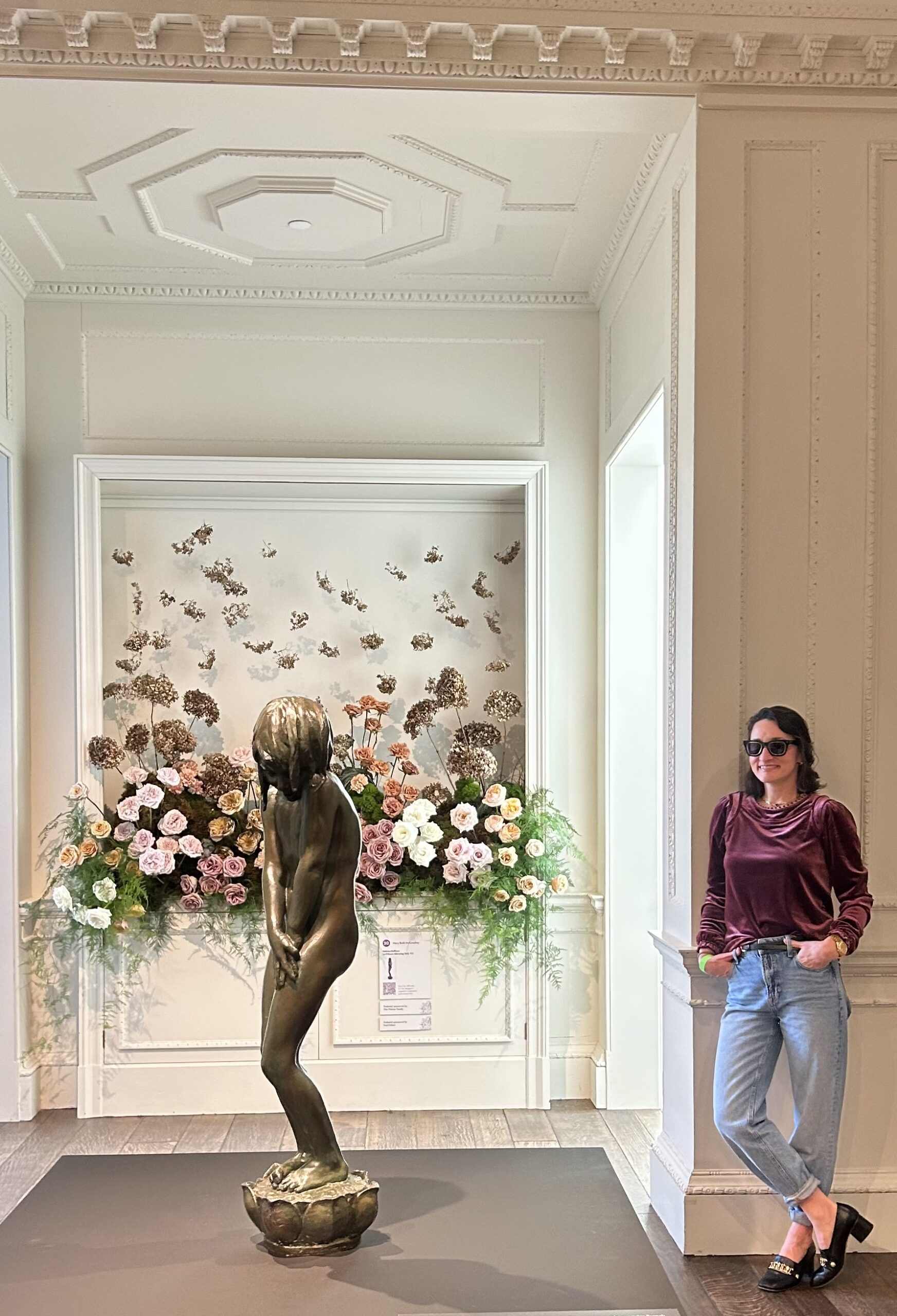
One misconception about floral design is that it is mere decoration.
Pretty flowers. Pretty tables. Pretty weddings.
But the floral work that interests me most operates much closer to art direction, installation, sculpture, and interpretation. The flowers themselves are only part of the work. What matters more is what they are communicating emotionally within a space.
This installation was created for Art in Bloom at the Westmoreland Museum of American Art, inspired by Shivering Girl, a bronze sculpture by Malvina Hoffman. This piece, from 1921, reflects the extraordinary technical skill and emotional sensitivity that distinguished a generation of early twentieth-century American women sculptors working within a largely male-dominated art world.
The sculpture itself carries enormous emotional weight. The posture is protective, inward, vulnerable without sentimentality. Nothing about it invites excessive floral abundance or decorative excess. In fact, too many flowers would have weakened the piece entirely. The challenge became creating floral work that responded to the sculpture psychologically rather than competing with it visually.
That distinction matters.
Good floral design is not simply the ability to arrange flowers attractively. It requires an intimate understanding of scale, proportion, architecture, negative space, tone, movement, color psychology, and how viewers physically experience a space as they move through it.
In this case, I became interested in the idea of raining trauma and psychological fragmentation.
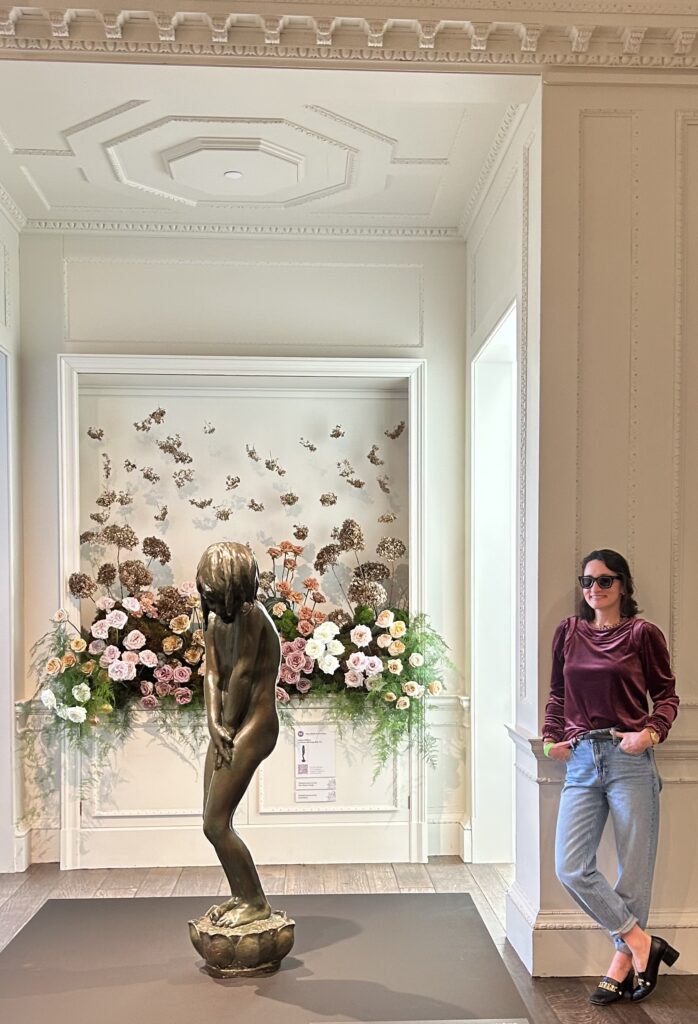
The bronzed hydrangeas pelting down were designed as pieces breaking apart and hurling themselves toward the girl. Dead hydrangeas from my garden fit the bill beautifully, retaining structure while becoming more fragile and skeletal over time. Bronzing them allowed them to move visually closer to the sculpture itself while still remaining botanical.
Below, the floral palette is restrained and muted: soft mauves, pale blushes, faded creams, dusty rose tones, layered greenery. I wanted the flowers to feel alive but subdued, almost as though they were emerging from shadow rather than performing brightness.
The installation was built specifically for the architecture of the niche as well.
This is something often underestimated about large-scale floral work: flowers cannot simply be “placed” into spaces arbitrarily. Architecture determines everything. Ceiling height, sightlines, molding details, lighting temperature, traffic flow, wall color, texture, viewing distance — all of these influence composition. Floral installation is spatial design as much as floral design.
And unlike many forms of visual art, floral installations are also temporary and physically demanding.
Every stem must be processed, conditioned, transported, installed, secured, hydrated, adjusted, and maintained while remaining visually effortless once complete. Large installations often involve ladders, mechanics, structural problem-solving, transportation logistics, and hours of invisible labor that viewers never see.
AND WATER! These flowers are alive! Every morning before the museum opens, florists come to refresh their designs, which for me this year meant misting my moss and watering my flowers. It’s a lot, honestly. There’s a ton of work behind the scenes that goes mostly unnoticed.
Which is perhaps part of why floral design is so frequently underestimated as an art form.
Because when it is done well, it feels natural. Emotional. Immediate. People experience the atmosphere before they consciously analyze the mechanics behind it.
But creating that feeling intentionally requires far more than simply “having good taste.”
It requires vision.
What interests me most about projects like this is the opportunity to use flowers not merely as decoration, but as interpretation — allowing botanical material to enter into conversation with sculpture, architecture, memory, and emotion itself.
That is where floral design becomes most meaningful.
Not simply arranging flowers beautifully, but creating work that changes the emotional temperature of a space.


